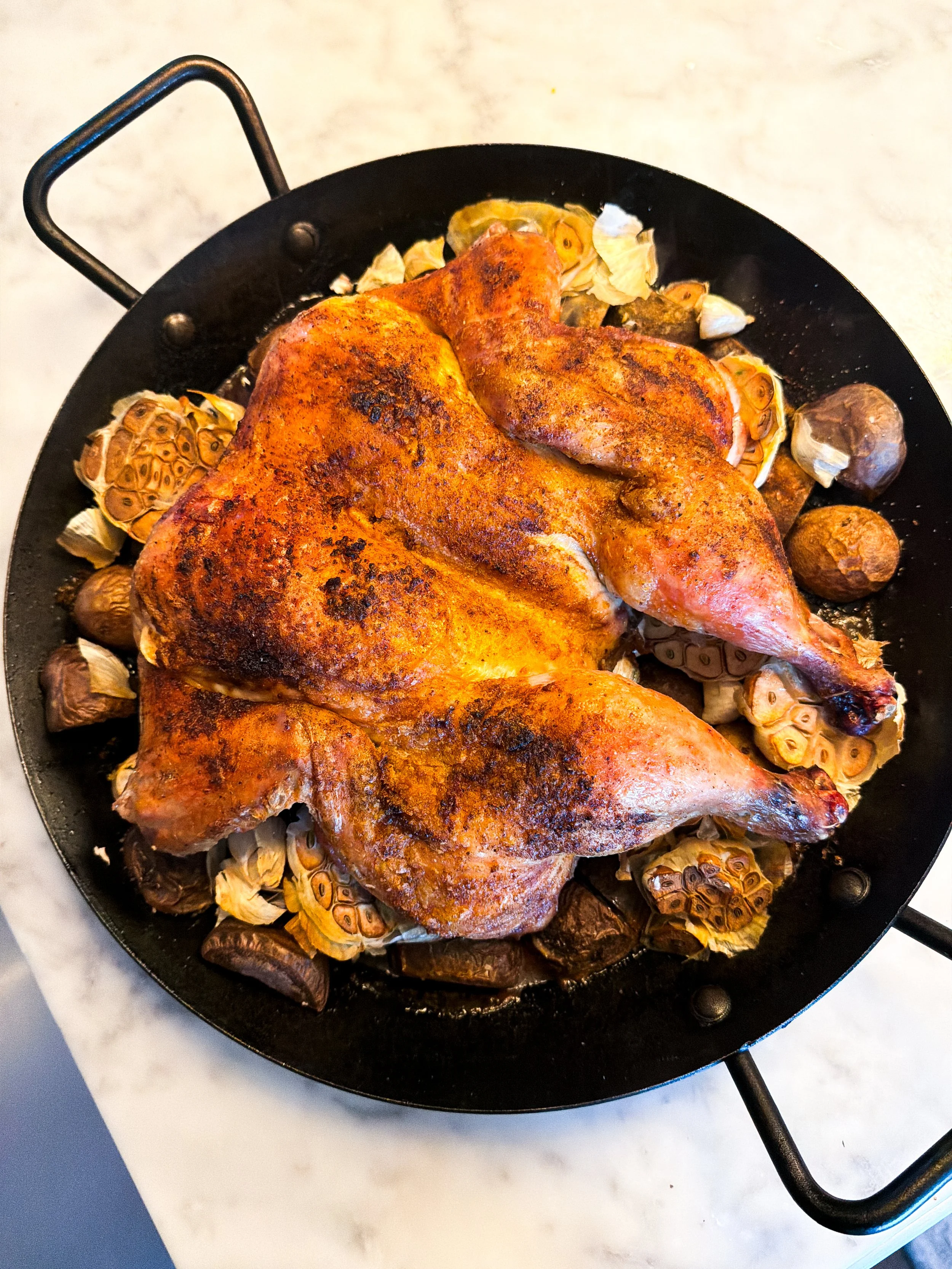
An easier version of traditional Spanish garlic chicken, with most of the cooking handled in the oven. A spatchcocked chicken rubbed with smoked paprika roasts over potatoes alongside halved heads of garlic, developing crisp skin while the potatoes soak up the drippings. Once everything is roasted, a quick stovetop reduction turns the pan juices, dry sherry, chicken stock, and softened garlic into a rich, glossy, sticky sauce.
The chicken, potatoes, and garlic cook together, so there’s no browning chicken in batches or tending a pan throughout dinner. When the chicken moves to the cutting board and the potatoes go onto a plate, you finish the sauce in the same pan.
Three heads of garlic, please
The garlic here is part of the meal. Three whole heads, halved across the middle, roast alongside the chicken until the cloves are soft enough to squeeze from their skins.
Loose cloves get mashed into the sauce. The halves that hold together go onto the platter with the chicken and potatoes, ready for anyone who wants a little more roasted garlic with each bite.
Smoked paprika brings warmth to the chicken, dry sherry gives the sauce depth, and lemon and sherry vinegar add a bright finish.
A sauce worth saving the drippings for
After roasting, the pan holds browned chicken juices, rendered fat, and bits of softened garlic, the starting point for the sauce.
With the chicken and potatoes removed, put the pan on the stovetop. Add sherry, scrape up the browned bits, and pour in the chicken stock. Loose roasted garlic, mashed cooked liver, and fresh thyme simmer with the juices before the sauce is strained.
The liver adds savory depth and body, while the stock and pan juices concentrate as they reduce. The finished sauce should be glossy, sticky, and still loose enough to spoon over the chicken and potatoes.
Use what comes with the chicken
Spatchcocking leaves you with a backbone that can become a small pot of stock while dinner roasts. Add the neck and giblets, if included, along with any saved chicken trimmings from the freezer. No carrots, celery, or mirepoix are necessary.
This quick stock goes straight into the pan sauce. Simmer it down with the drippings and use the sauce’s consistency as your guide.
The cooked liver gets mashed into the sauce with the roasted garlic and thyme, then strained out before serving. It contributes richness; the stock’s natural gelatin supplies the sticky texture.
If you already have gelatinous chicken stock ready to go, this becomes a true one-pan meal. Save the backbone, neck, and giblets for a future batch of stock.
Oven-Roasted Spanish Garlic Chicken (Pollo al Ajillo)
Spatchcocked chicken roasted over potatoes with whole heads of garlic and a glossy sherry-garlic pan sauce.
Yield: 4 servings | Prep time: 20 minutes | Cook time: Approximately 1 hour, plus 10–20 minutes for the sauce | Total time: Approximately 1 hour 30–40 minutes | Category: Main Course | Cuisine: Spanish-inspired | Method: Roasting, Stovetop
Equipment
20-inch paella pan suitable for oven and stovetop use, or a roomy cast-iron skillet
Small saucepan, if making stock
Cutting board, knife, and instant-read thermometer
Small fine-mesh skimmer or strainer
For the chicken, potatoes, and garlic
1 whole chicken, 3½–4½ pounds, spatchcocked; backbone, neck, and giblets reserved for stock
1½ pounds small Yukon Gold potatoes or other small waxy potato, halved; quarter any larger ones
3 whole heads of garlic, halved crosswise, loose outer paper removed
¼ cup olive oil, divided
2 teaspoons smoked paprika
Kosher salt and freshly ground black pepper
For the sherry-garlic sauce
3/4 cup dry sherry, such as fino or amontillado
1 1/2 cups unsalted chicken stock, preferably gelatin-rich, homemade as described below or prepared ahead; extra as needed
1 chicken liver, if included with the bird, cooked in the stock and reserved for the sauce
3 sprigs fresh thyme
1 tablespoon sherry vinegar, to taste
1 lemon, for a squeeze of juice and wedges to serve
For the optional quick stock
Reserved chicken backbone, neck, and giblets
Any additional saved chicken wings, necks, or trimmings, optional
Water to cover
Instructions
Heat the oven and start the stock, if needed. Heat the oven to 375°F convection, with a rack in the middle.
If making stock, place the backbone, neck, and giblets in a small saucepan with any extra chicken trimmings. Add just enough water to cover. Bring to a boil, then lower to a gentle simmer and partially cover. Let it simmer while the chicken roasts, adding water if needed to keep the pieces submerged. Once cooked through, reserve the liver for the sauce. Strain the stock when ready to use; you’ll need 1½ cups.
Arrange the potatoes and garlic. Toss the potatoes with 1 tablespoon olive oil, salt, and pepper. Arrange them cut-side down in the pan. Lightly oil the exposed faces of the garlic heads and nestle them split-side down among the potatoes, close to where the chicken will sit.
Season the chicken. Pat the chicken completely dry, including underneath. Rub with the remaining olive oil, then season all over with salt, pepper, and smoked paprika. Set it skin-side up over the potatoes, spreading the legs outward so it lies flat.
Roast everything together. Roast for approximately 55–75 minutes, beginning to check at 50 minutes. The potatoes should be tender and the chicken’s skin browned and crisp. If the skin browns too quickly, loosely cover the top with foil.
Check the thickest part of the breast and the innermost thigh and wing, avoiding bone; all should reach 165°F. USDA temperature guidance. If the drippings begin to scorch, add a small splash of water to that area of the pan.
Transfer the chicken and potatoes. Move the chicken to a cutting board to rest. Transfer the potatoes and intact garlic halves to a warm plate or platter and cover loosely. Leave loose roasted garlic cloves in the pan, removing their skins. If the potatoes need longer, let them finish roasting before starting the sauce.
Start the sauce on the stovetop. Set the pan over medium heat. For a large paella pan, use two burners if your stovetop accommodates it, adjusting the heat for an even simmer. There’s no need to increase the oven temperature.
Keep all the rendered chicken fat and drippings in the pan. Add the sherry (with the pan briefly off the flame if using gas), then return to the heat and scrape up the browned bits. Let it bubble for a minute or two.
Add the stock, liver, and thyme. Pour in 1½ cups chicken stock. Mash the loose roasted garlic and the cooked liver, if using, into the liquid, then add the thyme sprigs. If no garlic cloves have come loose, squeeze a few from one of the roasted heads.
Simmer uncovered, stirring occasionally, until the sauce is concentrated, glossy, and lightly coats a spoon, approximately 10–20 minutes. A wide paella pan may reduce faster, so begin checking early. If the sauce becomes too concentrated, loosen it with a splash of stock or water.
Finish, strain, and serve. Add the chicken’s resting juices and let the sauce briefly return to a simmer. Stir in a squeeze of lemon and 1 tablespoon sherry vinegar. Taste and adjust the salt, pepper, and acidity.
Remove the thyme stems, then strain the sauce through a small fine-mesh skimmer or strainer into a warmed bowl or jug. Stir well before spooning it over the food.
Carve the chicken and arrange it with the potatoes and roasted garlic. Spoon the sauce around the chicken and over the potatoes, and serve with lemon wedges.
Notes
For a true one-pan meal: Use gelatinous stock you already have on hand. Freeze the backbone, neck, and giblets for future stock; the liver enrichment is optional.
Choose dry sherry: Fino or amontillado works well. Avoid sweet cream sherry and salted cooking sherry.
Let the sauce guide you: Pan width affects reduction time. Stop when the sauce is glossy and coats a spoon but remains pourable. It will gain body as it cools slightly.
Keep the skin crisp: Spoon most of the sauce around the chicken and over the potatoes, leaving the browned skin exposed.
Round out the meal
Serve Puntarelle Caesar alongside for a crisp, bitter salad to balance the rich chicken and potatoes.